COSTA RICA FACTS
Costa Rica’s Rainforests are one of the last strongholds of biodiversity in the world. They harbor 5% of the planet’s biodiversity in a tiny country the size of West Virginia.
Costa Rica has 12 tropical life zones and the most varied fauna of any country in the world.
The vast number of plants, flowers, and colors truly make Costa Rica an Infinite Forest. Teaming with life here are: 850 species of birds, 209 species of mammals, 1500 species of trees, 220 species of reptiles & amphibians.
Nine active Volcanoes display the awesome power of Earth’s core.
Republic of Costa Rica is one of the oldest democracies in the Americas. It is politically stable and has no standing army.
Costa Rica is located in Central America, bordering both the Caribbean Sea and the North Pacific Ocean, between Nicaragua and Panama.
Costa Rica has a 93% literacy rate and 97% have access to healthcare.
At the beginning of the 16th century about 400,000 indigenous people lived in the territory that would become Costa Rica. By 1569, once the Spanish managed to gain a permanent foothold, there were only 120,000. By 1611 there were a mere 10,000 indigenous people left.
Much of Central America was conquered between 1519 and 1523 coinciding with the fall of Tenochtitlan (Aztec) in 1521.
Costa Rica is 51,100 sq. kms / 19,730 sq. miles.
CR lies at a boundary where the Pacific Coco’s plate (a piece of the earth’s crust 510km. Wide) meets the crustal plate underlying the Caribbean plate.
Almost a million of the known species on earth live in tropical rainforests.
800 species of ferns.
In the canopy many different plants can be found living in the tree branches or intertwining around them. Numerous small plants such as ferns, orchids, and bromeliads (pineapple family) have evolved to live above the forest floor. Usually these plants are not parasitic. They are using the host trees simply for their support and for added height in their quest for sunlight. “Epiphyte” is a Greek word for “upon plants.”
Rainforests cover over 7% of the earth’s land surface, but contain more than half of its living species of plants and animals.
No other country in the world has so much actively protected area per capita. Costa Rica is often viewed as a model for conservation.
Costa Rica’s first University was established in 1843.
Respecting the dignity of all human beings is a Costa
Rican reality. Slavery was abolished in 1823, the last execution held in
1859 and capital punishment officially abolished in 1883. Women won the right
to vote in 1949. Perhaps Costa Rica's racial tolerance comes from being a
very heterogeneous population; a mix of southern European, Asian, African
and indigenous American ancestry.
Costa Rica's 1016 kms. of Pacific and 212 kms. of Caribbean coastline offer
some of the most beautiful beaches on the planet and for surfers some of
the best waves in existence. Pavones, a left breaking wave on the southern
zone is the longest left breaking wave in the world.
90% of electricity in Costa Rica is hydro-electricity. |
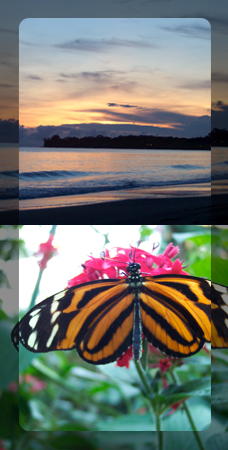





 Playa Negra Caribbean Sunrise